|
|||
![]() Deloeuil Blacksmith Shop |
In Spring, 1988k as construction began on this entry to Frenchman's bend Subdivision, archaeologists unearthed the remains of the house and blacksmith shop of Francois Deloeuil who located here circa 1789. It was the region's most extensive excavation of historic site from that period. Born in Quebec, Deloeuil came to Detroit by 1778 to work for the British Indian Department. When he moved to the River Raisin he located his forge here, in the heart of the "upper settlement." As a smith who repaired everything from guns to kettles and who forged all manner of iron tools, Deloeuil was a central figure in old Frenchtown. | ||
![]() Historic River Raisin |
"Remember the River Raisin" became a national battle cry in the War of 1812 after settlers and Kentucky soldiers were massacred by Indians on the river's banks in violation of protection promised by the British. The stream here was the center of a sturdy French-American settlement which took form 1760-86. In the period of controversy after the War of Independence and until 1794 British-Canadian authorities sought to establish the River Raisin as the international boundary and thus to retain possession of Michigan and control of the Great Lakes. Indians called the stream "Numasepp," or River of Sturgeon. French settlers changes the name to "Riviere aux Raisins" which means river of grapes. Early records tell of great masses of wild grapes which festooned the trees along its banks. | ||
![]() Major-General George Armstrong Custer |
Born in New Rumley, Ohio, George A. Custer grew up in the home of his half-sister, Mrs. David Reed. February 9, 1864 in the Presbyterian Church, he married Libbie Bacon, only daughter of judge Daniel S. Bacon. During the Civil War, he received six brevets and was made Major-General before he was 26 years old, a rare distinction. From 1866 until his death at the Battle of the Little Big Horn, General Custer Commanded the famous Seventh Calvary Regiment, leading them in scouting and Indian fighting throughout Kansas and the Dakota Territory. This statue of General Custer, created by Edward C. Potter was erected by the State of Michigan, Unveiled by Mrs. Elizabeth B. Custer and dedicated by President William Howard Taft, June 4, 1910. The statue was rededicated, September 3, 1955 by the First Calvary Division of which Custer's Seventh Calvary Regiment was a part. | ||
![]() The Navarre Anderson Trading Post |
In 1789, Heutrau Navarre, son of Detroit's Royal Notary, built this house, Michigan's oldest residence. Constructed of jointed timbers, it is considered the best example of French colonial architecture in the state. Originally Navarre used it as a depot for his fur trade business, but in 1798 converted it to his residence. After he sold it in 1802 it had two other prominent owners, John Anderson fur trader and local militia colonel and Joseph Dazet, physician and refugee from the French Revolution. To preserve the house the Ilgenfritz family moved it from its original location on Elm Street in Monroe in 1894. The Monroe County Historical Commission moved it here in 1972 and has restored it as a French homestead. Located at 3775 N. Custer & Raisinville Rd. on the Historic River Raisin. Call the Monroe County Historical Commission at (734) 240-7780 for hours and additional information. |
||
![]() St. Antoine, Riviere Aux Raisins |
Pioneer French families of the River Raisin community of 1788 petitioned for the establishment of a Roman Catholic Church on this site. A Chapel was build and it was dedicated in October of that year by a bishop who came by canoe from Montreal. St. Anthony Chapel this became a landmark upon the early map of that frontier period of Michigan History. Father Gabriel Richard, famed missionary-printer-priest of Detroit was minister of the parish 1805-27. Father Stephen Badin, the first Roman Catholic Priest ordained in the U.S.A. also served the parish. | ||
![]() Waterloo Dam |
Veterans Memorial Park was made possible by the use of trust funds resulting from civilian defense effort in Monroe County during World War II and by appropriations of the Monroe City Commission and the Monroe County Board of Supervisors. The park is dedicated to the war dead of the county and is open to all veterans of the county. Waterloo Dam, title to which was acquired to unite park lands on two banks of the river, marks the site of one of Michigan's earliest water power projects--the Waterloo Grist Mills which were built on the south bank of the river in 1820. The dam originally made of logs and heavy planking was re-built and concreted in 1904. | ||
![]() Frenchtown Township |
The French settled here 1780-1795 in long, narrow farms along the River Raisin and Swan Creek. The Americans wrested the territory from the British in 1796 as part of Wayne County, its status until 1805. When reorganized again in 1827, the Township extended from the Huron River to the Raisin River, from Lake Erie to Raisinville Twp. Later Ash Twp., the City of Monroe and Berlin Twp. were created from it. The present boundaries were established in 1867. The previous town hall, build in 1910, is now the adjacent library branch. This new town hall was dedicated in December 1973. | ||
![]() River Raisin Battlefield Visitor Center |
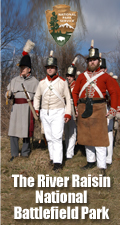
Located at 1403 East Elm Street on the Historic River Raisin. The battle fought here on Jan 22, 1813 was one of the largest engagements of the War of 1812. Of 934 Americans who fought here, only 33 escaped death or capture. The massacre of wounded soldiers the following day shocked and enraged Americans throughout the Old Northwest Territory. The display includes dioramas & full-size British & American soldiers, as well as a fiber-optic map presentation on the Battle of the River Raisin. Free admission. Call the Monroe County Historical Commission at (734) 240-7780 for hours and additional information. |
||
|
|||